Advertiser & Editorial Disclosure: The Bulkhead Seat earns an affiliate commission for anyone approved through the links below. This compensation may impact how and where links appear on this site. We work to provide the best publicly available offers to our readers. We frequently update them, but this site does not include all available offers. Opinions, reviews, analyses & recommendations are the author’s alone, and have not been reviewed, endorsed, or approved by any of these entities.
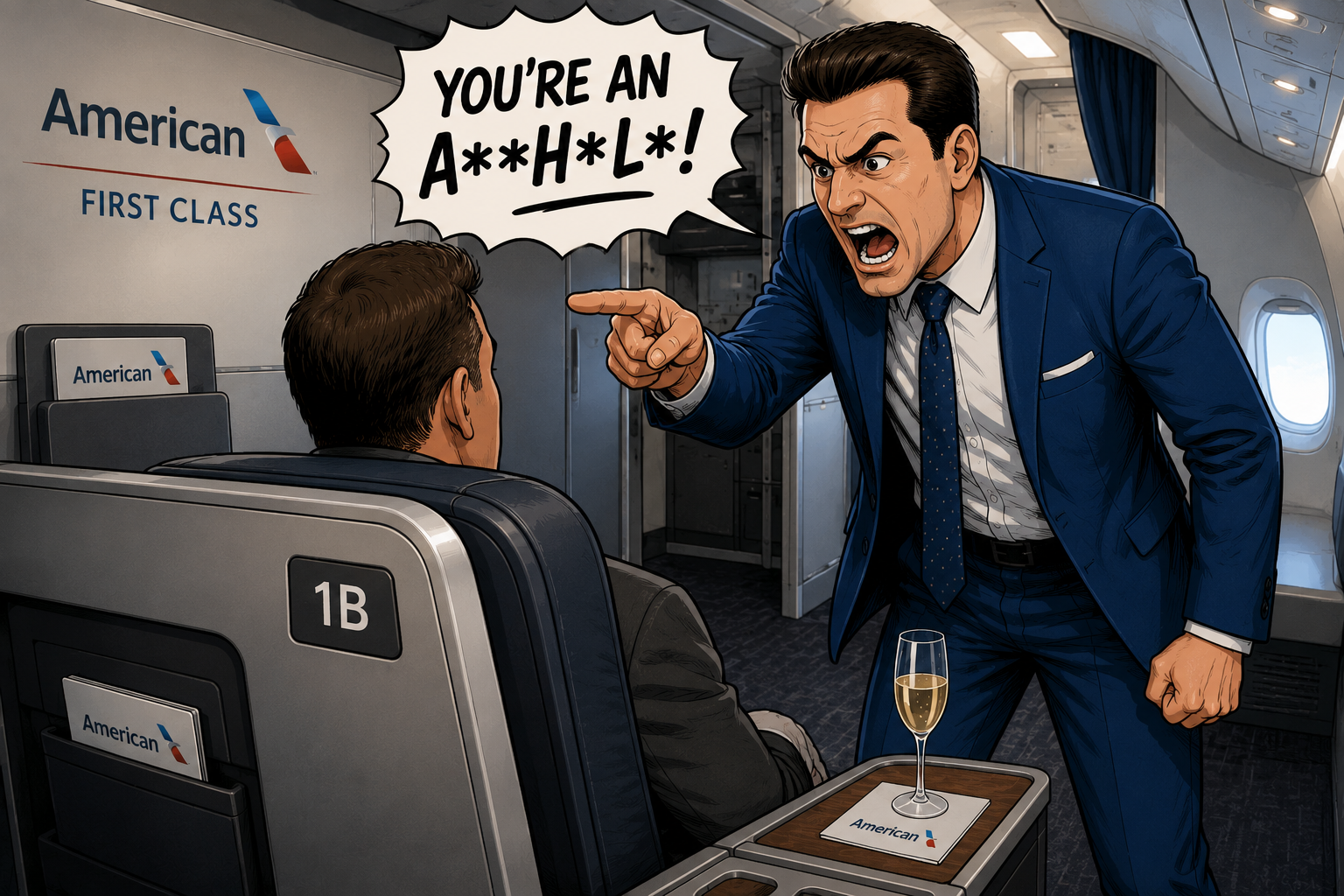
One Mile at a Time shared tips on airplane seat-swapping etiquette this morning and it made me remember an incident that occurred while I was flying from Chicago O’Hare International Airport (ORD) to Boston Logan International Airport (BOS) earlier this week on American Airlines. Another passenger awkwardly demanded that I move and proceeded to call me an a$*h&le before heading back to his assigned seat when I declined.
Few topics spark more debate among travelers than switching seats on an airplane. Every week, social media fills with stories of passengers refusing to swap seats, heated confrontations, and viral videos of arguments in the cabin. But while opinions differ on whether someone should change seats, one thing is almost universally true: insulting the person you’re asking rarely gets you what you want. There was no way I was moving after this entitled man’s behavior.
I was one of the first on the plane and settled into my seat (1B). A man (aged 50) boarded the plane and proceeded to say this to me:
Hey buddy. Yeah. Uh. I need you to grab seat 4E. Okay. Just a few rows back over there. Yeah. No biggie. Just take that one. It’s just over there and I’ll sit here.”
I told him that I was comfortable where I was and always book the bulkhead in First. He got annoyed and cursed at me before moving to his assigned seat (it was actually seat 4F). About five minutes later, a woman who was around half his age boarded. She was attractive, but not very bright. She was surprised she could not have her bags by her feet in the bulkhead and seemed generally confused. Then her phone lit up with some texts. I could see them with the way she was holding her phone and they were about me. The guy who wanted my seat to sit with this mystery woman was talking about how wrong I was not to move seats and proceeded to text a string of curses about me. She replied in kind while giggling. I said nothing. My gut was that this was an extramarital situation, but who knows. This self-important douche bag didn’t need to sit with his possible mistress for the two-hour flight. Had he asked nicely and said he was traveling with someone, I might have moved. But, after his tantrum there was no way I was switching seats.

Here are my tips on how to best navigate a seat chance. Again, no cursing is appropriate.
Remember: It’s a Request, Not an Obligation
When you book a flight, the seat shown on your boarding pass is the one you’ve paid for or selected. Whether it’s an aisle seat, a window seat, an exit row, or extra legroom, that seat belongs to you for the duration of the flight. That means another passenger is always free to ask if you’d be willing to switch, but you’re equally free to decline. No explanation is required.
Start With Courtesy
If you need to sit with a spouse, child, or travel companion, simply asking politely goes a long way. A simple, “Would you mind switching seats with me, so that I can sit with my [fill in relationship]?” is usually all that’s needed. If the answer is no, accept it gracefully.
Passengers often have good reasons for choosing their seat. They may have paid extra, need quick access to the aisle, want to be near the lavatory, have anxiety about flying, or simply prefer the location they selected months earlier. Those reasons aren’t always visible and they don’t have to be.
Make It an Equal or Better Trade
The best seat swap requests involve offering a comparable or better seat. Someone sitting in an aisle seat is understandably less likely to move to a middle seat several rows farther back. Likewise, asking someone to give up an exit row or premium seat for a standard Economy seat isn’t likely to succeed. The more equitable the exchange, the more likely someone is to say yes. In First Class, I always try aisle for aisle and window for window if I need to make the request. I once had a woman ask me to move from 1B to 37E so that she could sit with her husband who was in 1A. My reply, “maybe ask 37D to take 1A.” She was aghast.
Don’t Recruit the Cabin
One mistake some travelers make is trying to pressure another passenger by involving nearby travelers or making the interaction public. Rolling your eyes, loudly complaining, or announcing that someone “won’t switch seats” rarely changes the outcome. More often, it creates unnecessary tension before the aircraft has even left the gate.
Name Calling and Cursing Never Helps
Perhaps the quickest way to ensure someone refuses your request is to insult them. Calling another passenger selfish, rude, or entitled almost never persuades them to change their mind. Cursing and raising your voice also does not help. Instead, it escalates a simple request into a confrontation that may require flight attendants to intervene. Air travel is already stressful enough. A few harsh words can quickly sour the atmosphere for everyone seated nearby.
Flight Attendants Aren’t Seat Arbitrators
Unless there’s a safety issue or an operational reason requiring a passenger to move, flight attendants generally won’t force someone to give up the seat listed on their boarding pass. They may help find volunteers or facilitate a swap, but the final decision typically rests with the passengers involved.
A Little Kindness Goes a Long Way
Most travelers are surprisingly willing to help when they’re treated with respect. A polite request, an understanding attitude, and appreciation for either answer can turn what could have been an awkward interaction into a pleasant one.
Anthony’s Take: In the end, airplane etiquette comes down to a simple principle: asking is perfectly acceptable, refusing is perfectly acceptable, and treating each other with courtesy is far more likely to lead to a positive outcome than resorting to insults. I have half a mind to publish this guy’s name, but when you’re that entitled it will do nothing to change things anyway.
(Image Credits: ChatGPT and American Airlines.)
User Generated Content Disclosure: The Bulkhead Seat encourages constructive discussions, comments, and questions. Responses are not provided by or commissioned by any bank advertisers. These responses have not been reviewed, approved, or endorsed by the bank advertiser. It is not the responsibility of the bank advertiser to respond to comments.
Advertiser & Editorial Disclosure: The Bulkhead Seat earns an affiliate commission for anyone approved through the links above This compensation may impact how and where links appear on this site. We work to provide the best publicly available offers to our readers. We frequently update them, but this site does not include all available offers. Opinions, reviews, analyses & recommendations are the author’s alone, and have not been reviewed, endorsed, or approved by any of these entities.


1 comment
Throwing in some cash will help a lot as well.