Advertiser & Editorial Disclosure: The Bulkhead Seat earns an affiliate commission for anyone approved through the links below. This compensation may impact how and where links appear on this site. We work to provide the best publicly available offers to our readers. We frequently update them, but this site does not include all available offers. Opinions, reviews, analyses & recommendations are the author’s alone, and have not been reviewed, endorsed, or approved by any of these entities.
It’s Pride Month, but unfortunately a lot of the world is still not so friendly and in some cases regressing on rights afforded to LGBTQ+ individuals. The legal and social landscape for LGBTQ+ travelers is becoming more challenging in several countries recently, according to the newly released LGBTQ+ Risk Map 2026 from Safeture and Riskline.
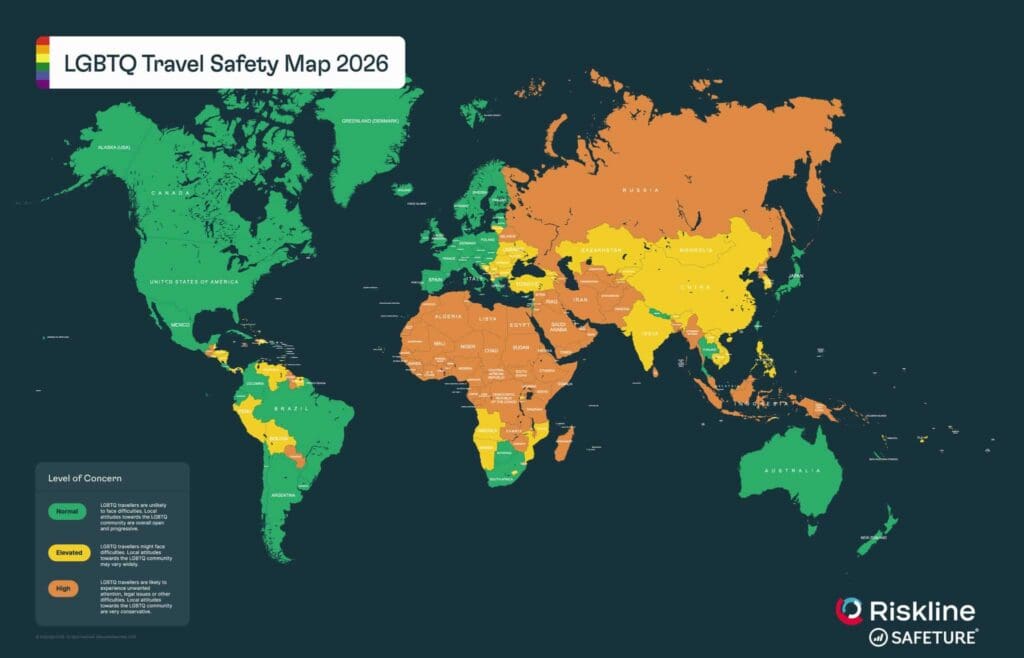
The annual assessment evaluates conditions for LGBTQ+ travelers across 233 countries and territories, measuring legal protections, social attitudes, and potential safety risks. This year’s report found that 91 countries are now classified as high risk for LGBTQ+ travelers, while 62 are considered medium risk and 80 are categorized as low risk.
The findings point to a concerning trend of legal rollbacks, stricter penalties, and new restrictions affecting LGBTQ+ individuals in a number of countries. Among those experiencing declining conditions are Belarus, Burkina Faso, India, Japan, Kazakhstan, Senegal, Slovakia, and sadly the United States.
Western Europe continues to rank as the safest region for LGBTQ+ travelers with every country in the region earning a low-risk classification. In contrast, much of the Middle East and North Africa remains among the highest-risk regions globally. Most countries in the region are classified as high risk, although Israel remains a low-risk destination and Lebanon is rated medium risk.
Sub-Saharan Africa continues to present significant challenges for LGBTQ+ travelers. Approximately 80% of countries assessed in the region fall into the high-risk category. Burkina Faso saw one of the most notable declines after introducing its first law criminalizing same-sex relations following the country’s 2022 military coup. In Senegal, penalties for same-sex relations have increased with prison sentences reportedly doubling.
Several European and Eurasian countries also experienced rating declines. Belarus adopted legislation targeting so-called “LGBT propaganda,” which could lead to fines or arrests. Kazakhstan introduced restrictions on information related to “non-traditional sexual orientations,” while Slovakia implemented additional limitations affecting same-sex couples.
In Asia, India’s risk rating declined following legislation that critics say restricts transgender individuals’ ability to self-identify. Meanwhile, Japan saw a setback after a court upheld the constitutionality of the country’s ban on same-sex marriage.
North America also saw changes reflected in the report. The United States received a lower rating due to new federal policies governing travel documents. Under current rules, passports will reflect only the sex assigned at birth, and the “X” gender marker is no longer recognized.
Despite the overall trend of increasing restrictions in some regions, the report also highlighted positive developments. Botswana and St. Lucia both improved their ratings after repealing laws that criminalized same-sex relations between men, marking significant progress for LGBTQ+ rights in those countries.
The LGBTQ+ Risk Map serves as a resource for travelers and organizations seeking to better understand potential legal and social challenges when traveling abroad. The report’s authors note that while many destinations remain welcoming and inclusive, travelers should stay informed about local laws and cultural attitudes before visiting unfamiliar countries.
Anthony’s Take: So much progress has been made, but there is still so far to go and a list of countries that I will never visit. As legal frameworks continue to evolve around the world, the 2026 findings underscore the importance of understanding not only travel logistics but also the rights and protections available to LGBTQ+ individuals in different destinations.
(Image Credits: United Airlines and Riskline.)
User Generated Content Disclosure: The Bulkhead Seat encourages constructive discussions, comments, and questions. Responses are not provided by or commissioned by any bank advertisers. These responses have not been reviewed, approved, or endorsed by the bank advertiser. It is not the responsibility of the bank advertiser to respond to comments.
Advertiser & Editorial Disclosure: The Bulkhead Seat earns an affiliate commission for anyone approved through the links above This compensation may impact how and where links appear on this site. We work to provide the best publicly available offers to our readers. We frequently update them, but this site does not include all available offers. Opinions, reviews, analyses & recommendations are the author’s alone, and have not been reviewed, endorsed, or approved by any of these entities.