Advertiser & Editorial Disclosure: The Bulkhead Seat earns an affiliate commission for anyone approved through the links below. This compensation may impact how and where links appear on this site. We work to provide the best publicly available offers to our readers. We frequently update them, but this site does not include all available offers. Opinions, reviews, analyses & recommendations are the author’s alone, and have not been reviewed, endorsed, or approved by any of these entities.
The sudden shutdown of Spirit Airlines after 34 years has sparked an unlikely grassroots movement with one passionate traveler proposing an unprecedented idea: what if the public bought the airline? There is no plan on how to run it differently, but people are flocking to pledge money in case this idea ever takes off.
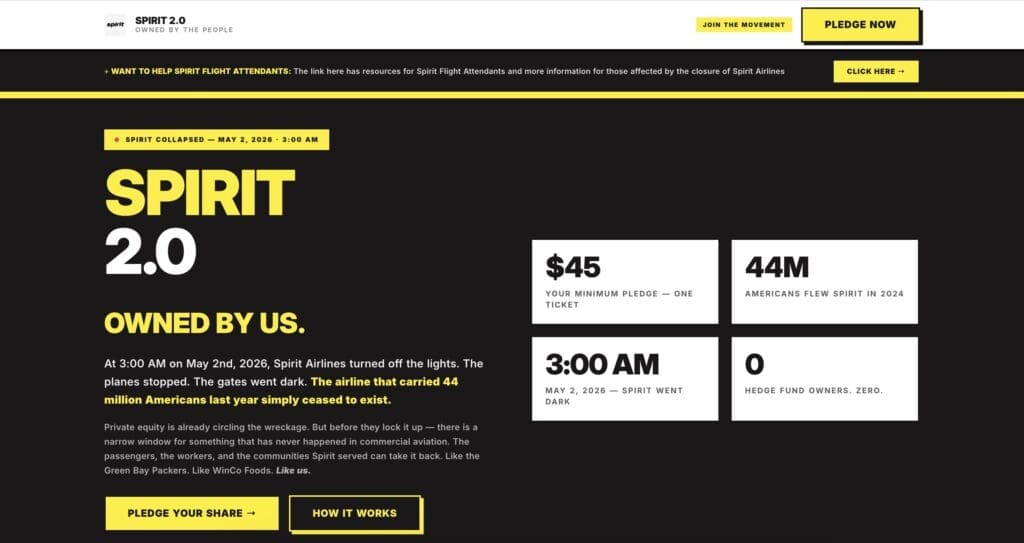
Within hours of Spirit ceasing operations early Saturday morning, Hunter Peterson (a voice actor and self-described super fan) launched “Spirit 2.0,” a campaign encouraging everyday people to band together and purchase the airline. What began as a joke quickly gained traction online with Peterson’s posts attracting millions of views and driving heavy traffic to a hastily built website promoting the idea.
Peterson’s vision draws inspiration from the Green Bay Packers, which is the only publicly owned team in the NFL. Instead of a single corporate owner or private equity firm, Spirit 2.0 would be owned collectively by passengers, employees, and supporters. The campaign’s message is simple: prevent private equity from acquiring the airline and instead create a community-owned carrier.
As of today, more than 512,000 people had pledged nearly $437 million in non-binding commitments. While no money has been collected yet, the campaign is aiming for $1.7 billion in total pledges. This is still far below previous valuations (such as the $3.8 billion acquisition attempt by JetBlue in 2022). Participants can register interest starting at $45.
Spirit’s shutdown followed years of financial instability, including layoffs, failed mergers, and a rejected $500 million government bailout. The closure left approximately 17,000 employees affected and thousands of passengers scrambling for alternatives. Other airlines, including United Airlines and American Airlines, have stepped in with discounted fares and expanded service to absorb displaced travelers.
While the idea of a publicly owned airline is unprecedented in the US, the rapid response highlights the strong emotional connection many travelers had with Spirit’s ultra-low-cost model. Still, significant challenges remain (from raising sufficient capital to navigating regulatory hurdles and rebuilding operations).
Anthony’s Take: I’d say that there is zero chance this goes anywhere, but Spirit 2.0 has tapped into a broader conversation about ownership, affordability, and the future of air travel. This is one of the most unusual responses to an airline collapse in recent history and likely will fizzle out soon. Even if the cash was collected and the airline was purchased, there is no plan to change how Spirit was run and to keep it solvent for the future.
(Image Credit: Spirit 2.0 Cooperative Initiative.)
User Generated Content Disclosure: The Bulkhead Seat encourages constructive discussions, comments, and questions. Responses are not provided by or commissioned by any bank advertisers. These responses have not been reviewed, approved, or endorsed by the bank advertiser. It is not the responsibility of the bank advertiser to respond to comments.
Advertiser & Editorial Disclosure: The Bulkhead Seat earns an affiliate commission for anyone approved through the links above This compensation may impact how and where links appear on this site. We work to provide the best publicly available offers to our readers. We frequently update them, but this site does not include all available offers. Opinions, reviews, analyses & recommendations are the author’s alone, and have not been reviewed, endorsed, or approved by any of these entities.