Advertiser & Editorial Disclosure: The Bulkhead Seat earns an affiliate commission for anyone approved through the links below. This compensation may impact how and where links appear on this site. We work to provide the best publicly available offers to our readers. We frequently update them, but this site does not include all available offers. Opinions, reviews, analyses & recommendations are the author’s alone, and have not been reviewed, endorsed, or approved by any of these entities.
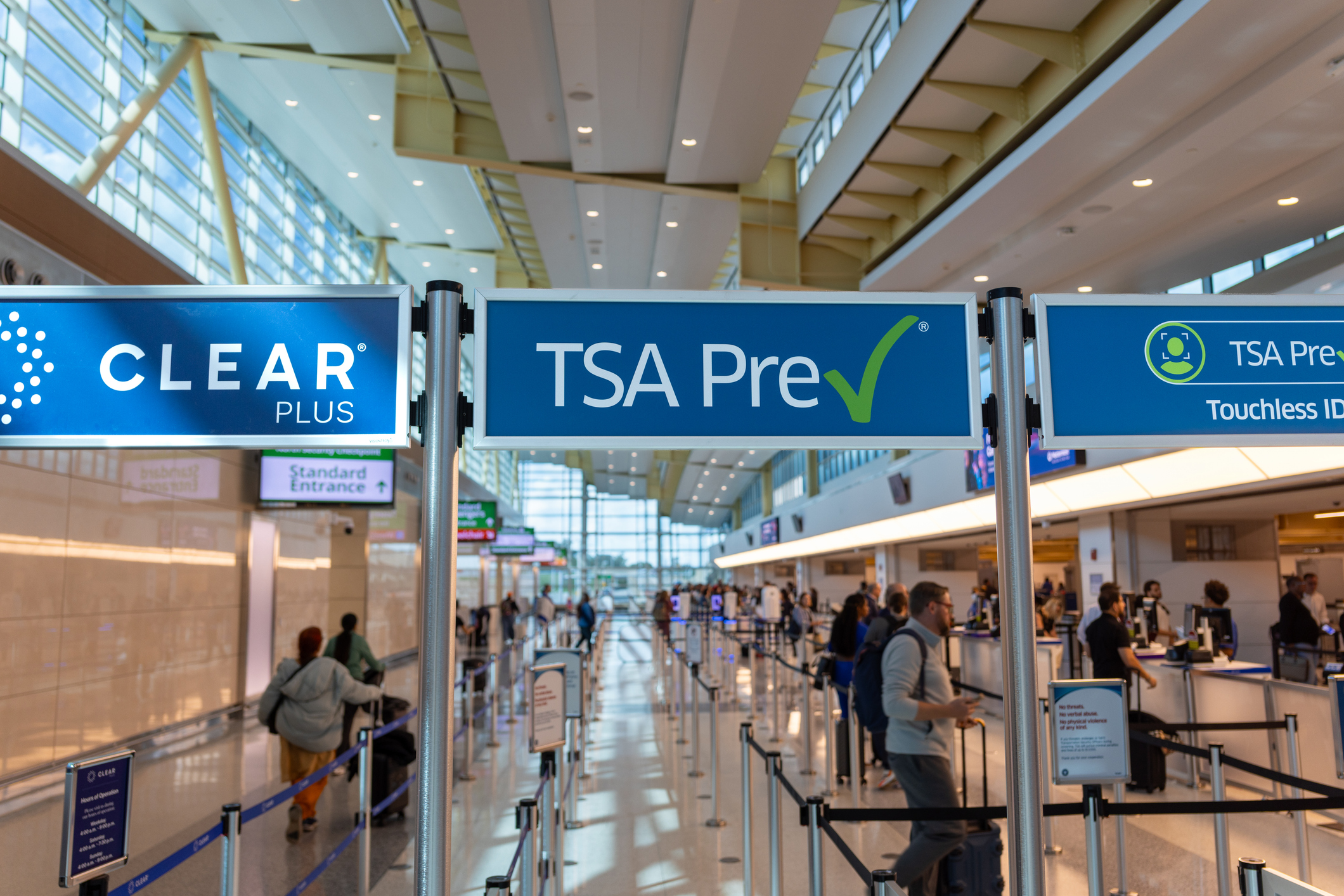
As long security lines plague major airports across the United States during the ongoing government shutdown, a group of airports is largely avoiding the chaos altogether. At 20 airports nationwide, security screening is handled not by the Transportation Security Administration (TSA), but by private contractors. So far, those airports are not seeing the same widespread delays.
Airports including San Francisco International Airport (SFO), Kansas City International Airport (MCI), and Orlando Sanford International Airport (SFB) participate in the TSA’s Screening Partnership Program, which allows private companies to operate security checkpoints under federal oversight. Despite following the same rules and standards as TSA-run checkpoints, these privately operated locations have avoided the large-scale staffing shortages affecting federally staffed airports. The key difference is flexibility. Private operators can set pay and staffing levels, which helps them maintain more consistent workforce coverage even during disruptions like a government shutdown.
Meanwhile, some of the country’s busiest airports are struggling. And, that’s putting it mildly. Houston’s George Bush Intercontinental Airport (IAH) and Hartsfield–Jackson Atlanta International Airport (ATL) have both experienced wait times exceeding two hours (day after day) over the past week as more than a third of TSA employees failed to report to work. The surge in absenteeism comes as TSA officers continue working without pay, which has led to operational strain and some of the longest security lines seen in years. President Trump has said that he is deploying ICE to airports beginning tomorrow, but that does not seem to be the solve and many are wondering how that would even work.
Despite the apparent advantages, airports cannot quickly switch to private screening. The process requires approval from TSA. This is followed by a lengthy contracting and transition period that can take up to a year or more. Once approved, TSA selects a contractor, which then needs additional time to fully take over operations. For many large airports, the complexity and risk of transitioning systems may outweigh the benefits (especially under normal conditions).
Supporters of private screening argue that contractors can be more efficient, cost-effective and better at maintaining staffing levels. Critics, including unions representing TSA workers, warn that private contracts (often awarded to the lowest bidder) could prioritize cost savings over security and lead to staffing or safety concerns. The debate is not new. Prior to September 11, 2001, all airport security in the United States was handled by private companies. This was before TSA was created to federalize the system.
The following airports currently participate in the Screening Partnership Program:
- Atlantic City International Airport (ACY)
- Charles M. Schulz-Sonoma County Airport (STS)
- Dawson Community Airport (GDV)
- Glacier Park International Airport (FCA)
- Great Falls International Airport (GTF)
- Havre City-County Airport (HVR)
- Kansas City International Airport (MCI)
- L. M. Clayton Airport (OLF)
- Orlando Sanford International Airport (SFB)
- Portsmouth International Airport (PSM)
- Punta Gorda Airport (PGD)
- Greater Rochester International Airport (ROC)
- Roswell International Air Center (ROW)
- San Francisco International Airport (SFO)
- Sarasota-Bradenton International Airport (SRQ)
- Sidney-Richland Municipal Airport (SDY)
- Sioux Falls Regional Airport (FSD)
- Tupelo Regional Airport (TUP)
- Wokal Field/Glasgow International Airport (GGW)
- Yellowstone Airport (WYS)
For a state that ranks 43rd in population, Montana has the largest number of airports with privatized security Seven on the list are found there. You might say that this works well for smaller airports, but some on the list like San Francisco International Airport (SFO) are huge global hubs.
As the shutdown continues and staffing shortages worsen at TSA-operated airports, the contrast between federally run and privately operated checkpoints is becoming more visible.
Anthony’s Take: While privatization is not a quick fix for the current crisis, the situation is reigniting debate over how airport security should be managed and whether more airports should consider alternative models in the future.
(Featured Image Credit: Greggory DiSalvo via iStock.)
(H/T: CNN.)
User Generated Content Disclosure: The Bulkhead Seat encourages constructive discussions, comments, and questions. Responses are not provided by or commissioned by any bank advertisers. These responses have not been reviewed, approved, or endorsed by the bank advertiser. It is not the responsibility of the bank advertiser to respond to comments.
Advertiser & Editorial Disclosure: The Bulkhead Seat earns an affiliate commission for anyone approved through the links above This compensation may impact how and where links appear on this site. We work to provide the best publicly available offers to our readers. We frequently update them, but this site does not include all available offers. Opinions, reviews, analyses & recommendations are the author’s alone, and have not been reviewed, endorsed, or approved by any of these entities.


6 comments
So back to pre 9/11. Cool.
i remember pre 9/11 and airport security in many many places wasn’t cool.
Thank you! I am based out of MCI and have not had any issues during the shutdown(s). While I think the entire thing is a debacle and our government employees deserve far more (regardless of what people think of TSA), this explains why my flights from MCI have felt as smooth as ever and also reassures me for my work trips this week.
I only hope we can overcome the ridiculous and juvenile antics of DC so the other hard working folks can put food on their tables without accruing credit card interest or needing food bank hand outs because others won’t work.
I’m going Captain Obvious here but of course non-TSA airports don’t have the TSA problems. TSA doesn’t work there. The whole reason TSA was brought into being was the utter lack of consistency by private contractors before 9/11. Some of those people were so terribly trained to handle their jobs of aviation safety that they may as well have worked for ICE.
I live in Orlando and fly from MCO and SFB regularly. The TSA personnel at MCO are hostile… barking orders at you and behaving poorly. The TSA agents at SFB are friendly and infinitely more patient. Maybe the old model needs to go.
So why aren’t the individual airline responsible for flight security? Why is this an issue for the federal government to solve? The feds aren’t very good at market based problem solving. Let American and Southwest and carriers be responsible for safety and security.