Advertiser & Editorial Disclosure: The Bulkhead Seat earns an affiliate commission for anyone approved through the links below. This compensation may impact how and where links appear on this site. We work to provide the best publicly available offers to our readers. We frequently update them, but this site does not include all available offers. Opinions, reviews, analyses & recommendations are the author’s alone, and have not been reviewed, endorsed, or approved by any of these entities.
Global airlines are scrambling to cancel, reroute, and suspend flights across the Middle East after US/Israeli military strikes on Iranian targets prompted widespread airspace closures across the region. At approximately 6:45 AM UTC, Israel announced it had conducted pre-emptive strikes on Iran. Both countries immediately shut their airspace and the United States later confirmed its involvement. In rapid succession, Bahrain, Jordan, Kuwait, Iraq, Qatar, and the United Arab Emirates also closed their airspace to civilian traffic. Syria partially closed its near its border with Israel.
The result has been a near-total halt of commercial overflights across one of the world’s most critical aviation corridors. Flight tracking data shows Iranian airspace completely devoid of traffic. According to aviation analytics firm Cirium, more than 200 inbound flights to the Middle East were canceled within hours of the escalation. This figure is expected to rise significantly.
The disruption has extended far beyond the immediate region. Long-haul flights that rely on Middle Eastern overflight rights have been forced to divert or return to their departure points. An American Airlines flight from Philadelphia International Airport (PHL) to Doha’s Hamad International Airport (DOH) reportedly turned back more than six hours after departure. An Air Canada flight from Toronto Pearson International Airport (YYZ) to Dubai International Airport (DXB) remained airborne for more than 10 hours before being diverted.
Multiple airlines have announced suspensions of service to the region extending into next month. Air Canada, Air France, British Airways, Ethiopian, Finnair, Iberia, ITA Airways, KLM, Lufthansa, Turkish Airlines, and Wizz Air have all suspended flights to affected destinations. Gulf carriers including Emirates, Etihad Airways, flydubai, and Qatar Airways have warned of significant network disruption (though some services continue where possible).
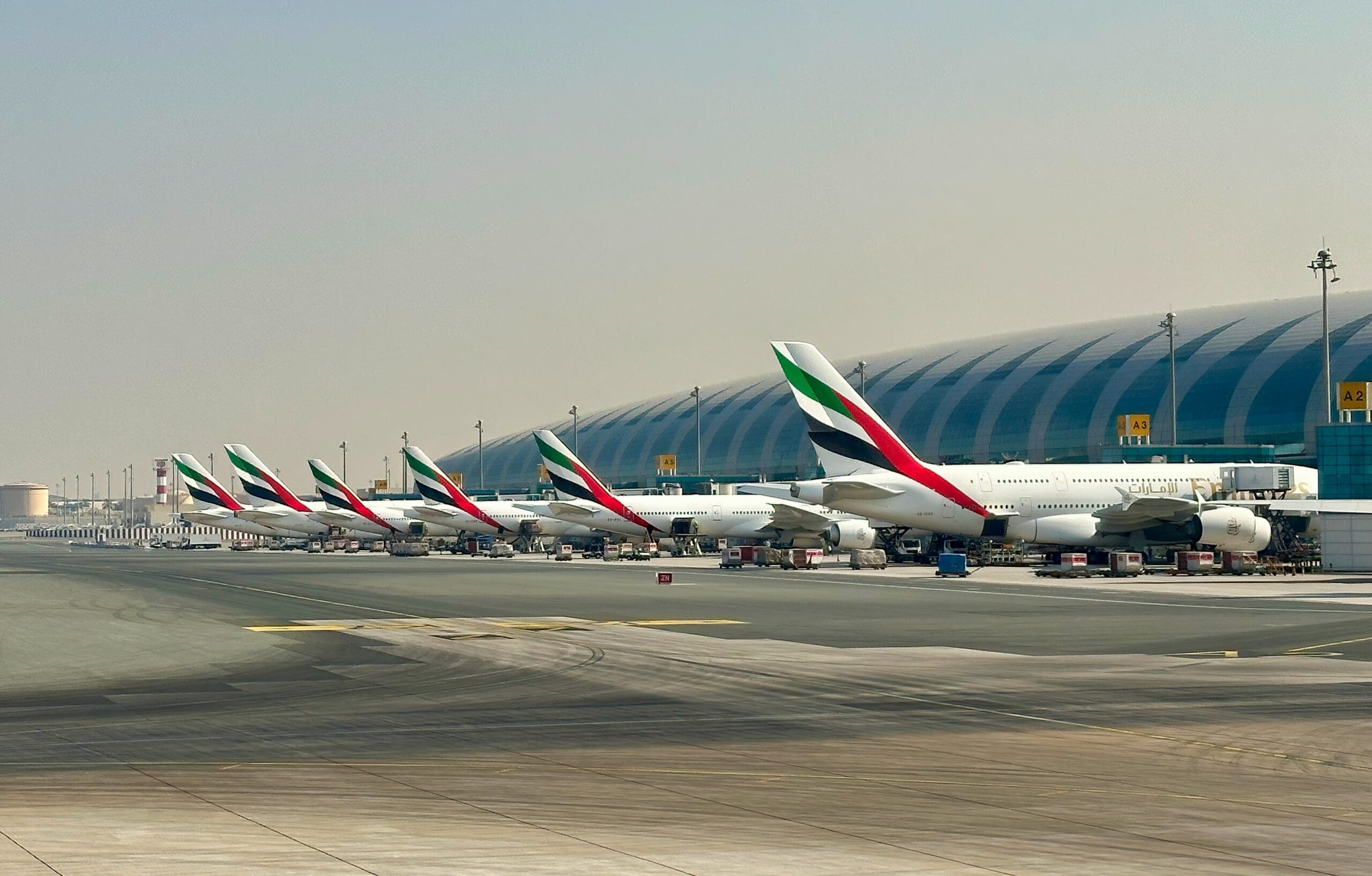
The operational impact has been especially acute at major Middle Eastern hubs. Dubai International Airport (DXB) has temporarily halted takeoffs and landings. FlightAware data indicates more than 280 flights have been canceled at Dubai alone, with an additional 250 delayed.
Other airports experiencing major disruption include:
- Abu Dhabi’s Zayed International Airport (AUH)
- Doha’s Hamad International Airport (DOH)
- Jeddah’s King Abdulaziz International Airport (JED)
- Kuwait International Airport (KWI)
- Tel Aviv’s Ben Gurion Airport (TLV)
These airports serve as primary hubs for some of the world’s largest hub-and-spoke carriers, which magnifies the global ripple effects.
The Middle East plays a central role in global aviation, particularly for flights between Europe and Asia. The closure of multiple national airspaces disrupts not only point-to-point travel but also long-haul routes that depend on efficient overflight paths. Airlines have already been operating around restricted airspace in recent years (particularly avoiding Iranian and Russian airspace). These detours significantly increase flight times, fuel burn, and operating costs. Industry analysis suggests Gulf carriers have been incurring thousands of dollars in additional fuel costs per flight hour due to suboptimal routing.
Prolonged restrictions could become financially unsustainable for many airlines (especially those operating ultra-long-haul routes). European carriers in particular have faced similar challenges due to Russian airspace closures affecting Asia-bound services.
It remains unclear how long the current airspace closures will remain in effect. Previous regional shutdowns have sometimes lasted only days, though the fluid and highly dynamic nature of the situation makes forecasting difficult.
Anthony’s Take: For now, airlines and passengers alike face significant uncertainty as one of the world’s most strategically important aviation regions remains largely closed to civilian traffic.
(Featured Image Credit: Nigel Harris via iStock.)
User Generated Content Disclosure: The Bulkhead Seat encourages constructive discussions, comments, and questions. Responses are not provided by or commissioned by any bank advertisers. These responses have not been reviewed, approved, or endorsed by the bank advertiser. It is not the responsibility of the bank advertiser to respond to comments.
Advertiser & Editorial Disclosure: The Bulkhead Seat earns an affiliate commission for anyone approved through the links above This compensation may impact how and where links appear on this site. We work to provide the best publicly available offers to our readers. We frequently update them, but this site does not include all available offers. Opinions, reviews, analyses & recommendations are the author’s alone, and have not been reviewed, endorsed, or approved by any of these entities.