Advertiser & Editorial Disclosure: The Bulkhead Seat earns an affiliate commission for anyone approved through the links below. This compensation may impact how and where links appear on this site. We work to provide the best publicly available offers to our readers. We frequently update them, but this site does not include all available offers. Opinions, reviews, analyses & recommendations are the author’s alone, and have not been reviewed, endorsed, or approved by any of these entities.
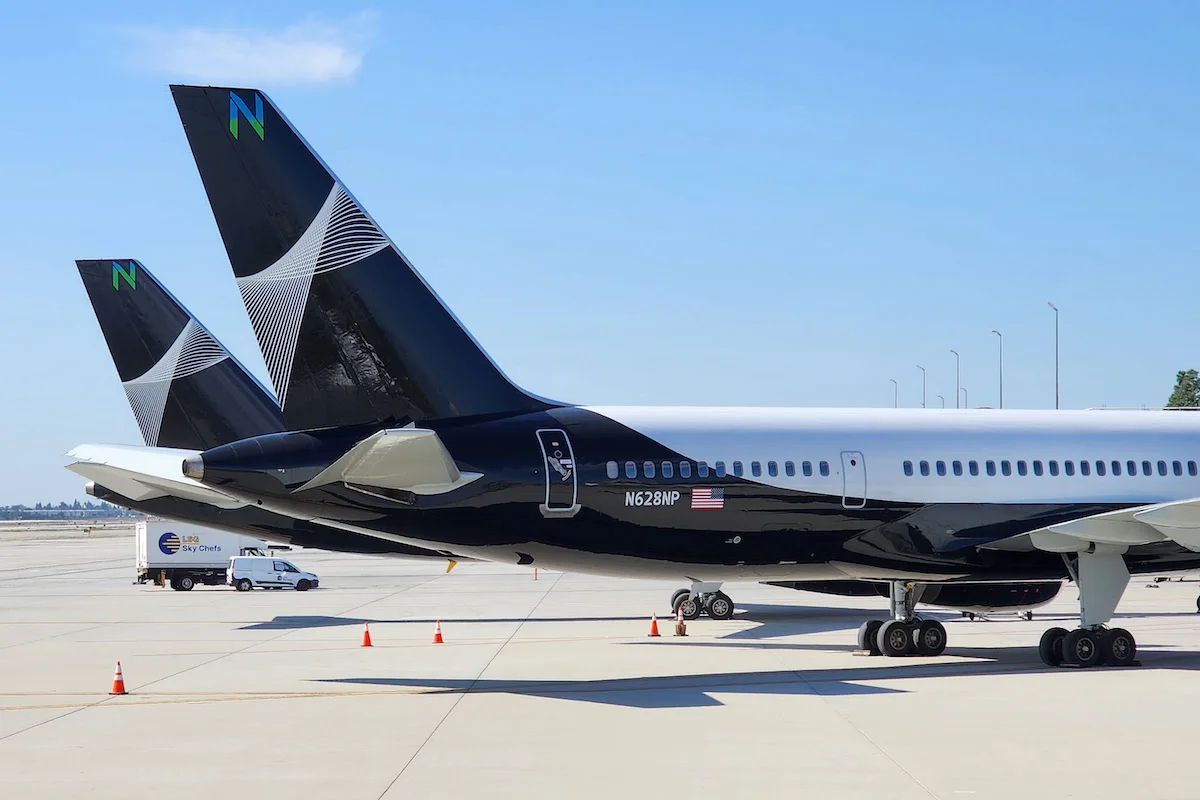
I’ve written about New Pacific Airlines several times over the past few years. In September 2023, the carrier planned to fly between Ontario International Airport (ONT) and Las Vegas Harry Reid International Airport (LAS), Nashville International Airport (BNA), and Reno-Tahoe International Airport (RNO). Las Vegas and Reno got the axe with Nashville ceasing shortly after. After that, it aimed to reinvent transpacific travel through Anchorage’s Ted Stevens Anchorage International Airport (ANC) with flights to Asia. That never came to be and this week, the airline shut down.
Originally launched as Northern Pacific Airways, the company envisioned an Icelandair-style connecting hub in Anchorage’s Ted Stevens Anchorage International Airport (ANC). The plan was to shuttle travelers between North America and Asia using Boeing 757-200 aircraft. The idea never materialized. Even before the airline could test its long-haul strategy, Russia’s airspace closure to US carriers effectively blocked any chance of operating competitive routes to Asia. Without viable flight paths, the core business model collapsed before it could get off the ground.
After New Pacific ended all scheduled service, it pivoted entirely to charter operations. A portion of the Boeing 757 fleet was reconfigured with 78 Business Class seats for sports teams and corporate clients.
New Pacific operated four Boeing 757-200s, most of which were acquired secondhand from American Airlines. While the aircraft type has long been favored for niche long-range missions, its age, fuel consumption, and maintenance needs made it a challenging foundation for an airline attempting to scale. The company also explored a variety of alternative strategies, including potential operations to Mexico and even had ambitions to base aircraft in Saipan. None of these plans came to fruition.
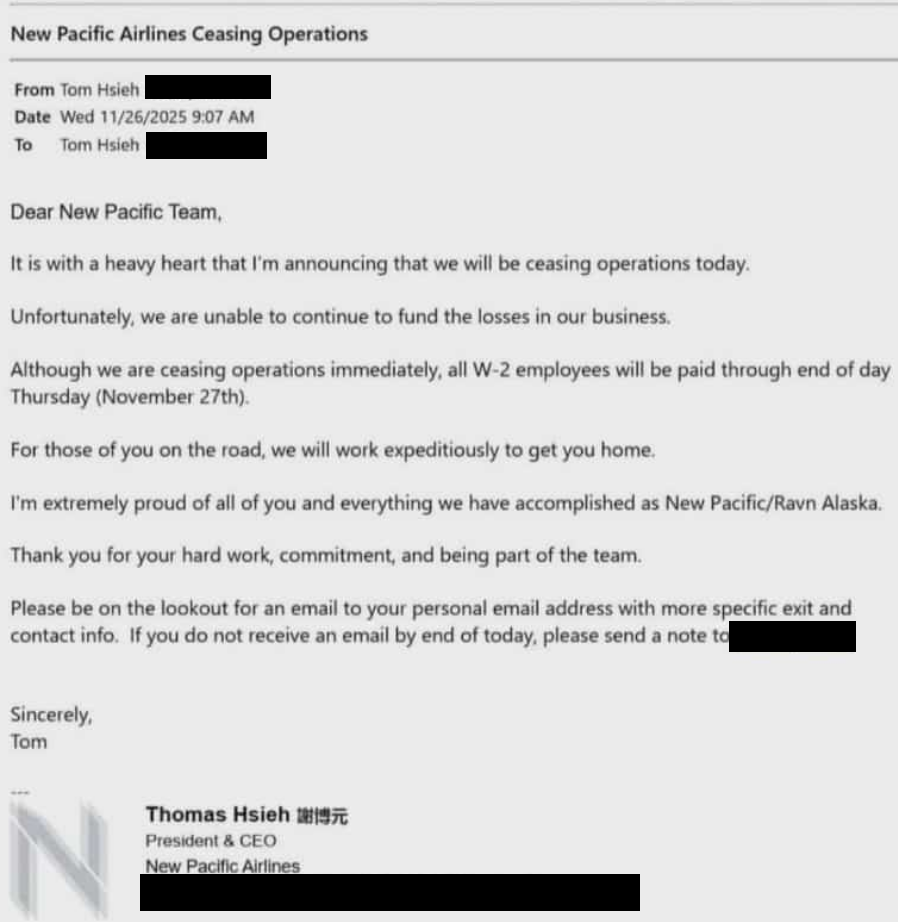
View from the Wing shared the email above from the airline’s CEO telling employees that the carrier was shutting down operations. Industry observers have long questioned whether New Pacific’s concept was viable. The abrupt shift away from its Anchorage hub model, followed by its brief and unfocused attempt at domestic service, signaled deep structural issues. While the airline’s closure is disappointing for its staff, the demise itself is not surprising. The idea of building a global connecting hub in Alaska was ambitious but proved incompatible with geopolitical realities and economic constraints.
Anthony’s Take: With New Pacific now out of business, its story will likely be remembered as a cautionary tale. That said, there is always another airline looking to start up and I’m sure we’ll hear about new ones attempting similar feats in the future.
User Generated Content Disclosure: The Bulkhead Seat encourages constructive discussions, comments, and questions. Responses are not provided by or commissioned by any bank advertisers. These responses have not been reviewed, approved, or endorsed by the bank advertiser. It is not the responsibility of the bank advertiser to respond to comments.
Advertiser & Editorial Disclosure: The Bulkhead Seat earns an affiliate commission for anyone approved through the links above This compensation may impact how and where links appear on this site. We work to provide the best publicly available offers to our readers. We frequently update them, but this site does not include all available offers. Opinions, reviews, analyses & recommendations are the author’s alone, and have not been reviewed, endorsed, or approved by any of these entities.