
Advertiser & Editorial Disclosure: The Bulkhead Seat earns an affiliate commission for anyone approved through the links below. This compensation may impact how and where links appear on this site. We work to provide the best publicly available offers to our readers. We frequently update them, but this site does not include all available offers. Opinions, reviews, analyses & recommendations are the author’s alone, and have not been reviewed, endorsed, or approved by any of these entities.
Austin-Bergstrom International Airport (AUS) is undertaking a huge expansion that will nearly double the size of the airport when it adds 32 new gates and transforms airport operations at the Texas capital. The more than $5 billion plan includes two new remote satellite concourses (Concourse B with 26 gates and Concourse M with six gates) and a series of supporting projects scheduled for completion by the mid-2030s.
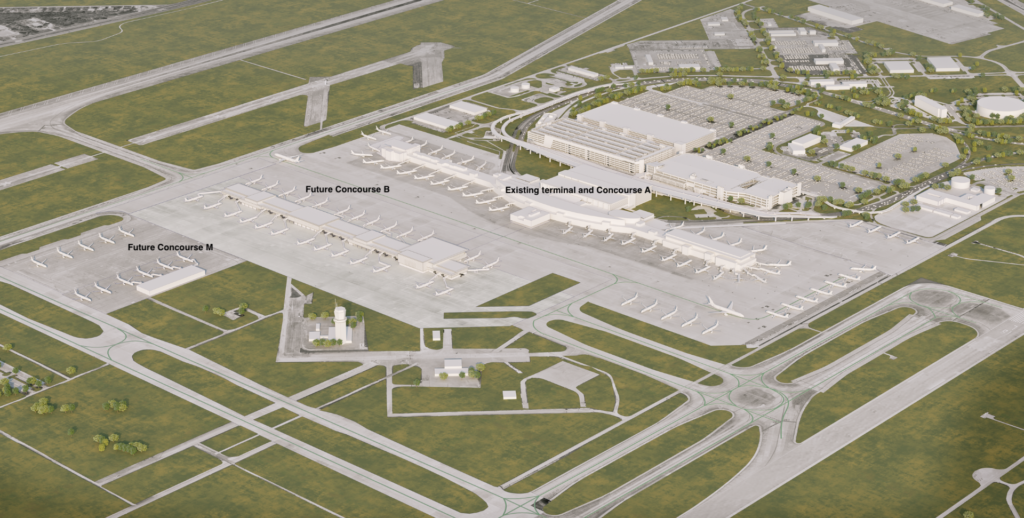
Southwest Airlines is the dominant carrier at Austin-Bergstrom International Airport (AUS). It will anchor Concourse B with 18 gates (an increase of eight) while United Airlines will operate five gates there. Three additional gates in the concourse will be available for common domestic use. Concourse M will provide six more gates to support phasing, new entrants, and irregular operations. Its facilities will include concessions, restrooms, and gate hold rooms. Bus transport will connect passengers between the Barbara Jordan Terminal and Concourse M.
The existing terminal and Concourse A currently feature 34 gates. Once redevelopment is complete, Concourse A will house all international operations along with non-signatory airlines (these are carriers that don’t have a long-term, formal airline operating agreement with the airport). Delta Air Lines will serve as the anchor tenant with 15 gates, American Airlines will occupy nine, and Alaska Airlines will have one. Eight gates will remain common-use and capable of serving both international and domestic flights.
The expansion follows years of explosive traffic growth that has strained airport infrastructure. From January through November 2025, Austin-Bergstrom International Airport (AUS) handled 19.8 million travelers (nearly 25% more than the same period in 2019). Delta increased available seats by 80% over that time frame, followed by Southwest at 66%, American at 20%, and United at almost 13%. Even with accelerated growth, Delta still offered fewer than half the seats Southwest flew from Austin in 2025.
The multi-phase expansion will begin with a three-gate western extension to the existing concourse in late 2026. Construction of Concourse B will require demolition of the South Terminal (currently used by Allegiant Air and Frontier Airlines) as well as excavation for a pedestrian tunnel linking the new facility to the main terminal. Concourse M will act as a release valve during construction and continue to provide flexibility after Concourse B opens.
Beyond new gates, projects will reshape the passenger journey from curbside to departure gate. A redesigned arrivals and departures hall will introduce a centralized TSA checkpoint, expanded ticket counters, a new baggage claim hall, upgraded concessions, a mobility lounge, and a meet-and-greet space. A new pedestrian bridge will offer direct access between the terminal, parking garages, and the rental car center.
Supporting the expanded airfield and terminal footprint, Austin-Bergstrom International Airport (AUS) will invest in a campus-wide utility infrastructure program and a new central utility plant to increase capacity for heating and cooling, electrical power, telecommunications, stormwater management, and deicing operations. These upgrades are designed to support future growth well beyond the current expansion horizon.
Anthony’s Take: With its rapidly growing metro area, rising corporate presence, and an increasingly competitive airline market, the overhaul at Austin-Bergstrom International Airport (AUS) aims to deliver both capacity and flexibility for the future. I’m excited to see all of the changes once complete. I always enjoyed flying in and out of Austin in the past (it has been a few years).
(Image Credits: Florence-Jones via Unsplash and Austin-Bergstrom International Airport.)
User Generated Content Disclosure: The Bulkhead Seat encourages constructive discussions, comments, and questions. Responses are not provided by or commissioned by any bank advertisers. These responses have not been reviewed, approved, or endorsed by the bank advertiser. It is not the responsibility of the bank advertiser to respond to comments.
Advertiser & Editorial Disclosure: The Bulkhead Seat earns an affiliate commission for anyone approved through the links above This compensation may impact how and where links appear on this site. We work to provide the best publicly available offers to our readers. We frequently update them, but this site does not include all available offers. Opinions, reviews, analyses & recommendations are the author’s alone, and have not been reviewed, endorsed, or approved by any of these entities.